
Loading...
Loading...
How a pro fight is actually governed: the local commission runs the night, the belt bodies run the title. Anchored on the British Boxing Board of Control.
Written for BoxerConnect and current for the 2025 rulebooks. This is a plain-English guide, not the letter of the law: for a decision that counts, use the official rulebook.
Here is the thing almost nobody tells you when you first sit down at ringside. There is no single rulebook that all the world's top professionals fight under. There is no head office of boxing. Instead, every professional fight sits inside a stack of rules, layered one on top of the other, and two completely different organisations are in charge of different parts of it.
Get this one idea straight and a lot of boxing's strangeness suddenly makes sense. The organisation that legally runs fight night is not the same organisation whose belt is on the line. They are separate bodies, with separate rulebooks, doing separate jobs.

The organisation that runs the night is called the commission. The commission is the local authority for boxing. It licenses the boxers so they are allowed to fight at all, it appoints the officials, it sets the medical requirements and it enforces what happens on the night. In Britain that is the British Boxing Board of Control, the BBBofC. In the United States there is no national body at all, so a single state does the job, such as Nevada or California.
The other organisation is the belt body, also called a sanctioning body. These are the famous initials: the WBC, the WBA, the IBF and the WBO. A belt body does not run the night. It does not license anyone or hire the referee. What it does is decide who is its champion, name the one challenger a champion is obliged to fight next (the mandatory challenger), and add its own extra rules for its own title fights.
So on any given fight night you have two layers of rules at least, sometimes three:
What happens when the two layers disagree? For the event itself, the commission usually wins. Nevada, for example, adopts the widely used unified rules but states plainly that Nevada law controls if there is a clash. The WBA, the WBC and the WBO all accept, in their own rulebooks, that local commission rules can override theirs. The people who run the night have the final say over the night.
But, and this is the clever part, the belt body keeps a power of its own that the commission cannot touch. Even when the official result stands, a belt body can decide the fight does not count towards its title. The WBC, for instance, can rule a bout non-title for its own purposes and deny either boxer any championship rights from it. So a boxer can genuinely win the fight, have the win go on his record, and still gain nothing at all towards the belt.
That is why the useful question is never "which book do they fight to?" There is no single book. The useful question is "which stack of rules applies to this particular bout?" Being called the best pound-for-pound boxer in the world does not summon a special rulebook. It just means the belt bodies are more likely to come knocking with their obligations. On BoxerConnect, the amateur end, the picture is simpler, but the same instinct helps: always ask who is sanctioning the bout and under whose rules, because that is who sets the terms.
The host commission licenses the boxers, appoints the officials, sets the medical requirements and enforces fight-night procedure. In Britain that is the BBBofC; in the US it is a state commission such as Nevada or California.
In plain English: One local body is legally in charge of the whole event, from who is allowed to fight to which doctor is at ringside. The belt bodies do none of this.
A belt body (WBC, WBA, IBF or WBO) decides who is its champion, names the mandatory challenger and adds its own title-fight rules, but does not run the event.
In plain English: The WBC or WBA controls its own belt and nothing else. It does not license anyone or hire the referee.
Where commission rules and belt-body rules conflict, the local commission's law usually controls the event; Nevada adopts the unified rules but says Nevada law controls in a conflict, and the WBA, WBC and WBO all accept local rules can override theirs.
In plain English: If the two rulebooks disagree on the night, the people running the night win. But the belt body still keeps the separate power to decide what counts towards its title.
| Job | Local commission (e.g. BBBofC, Nevada) | Belt body (WBC/WBA/IBF/WBO) |
|---|---|---|
| Licenses the boxers | Yes | No |
| Appoints referee and judges | Yes | Proposes/approves for its title fights |
| Sets medical requirements | Yes | Adds advisory extras |
| Decides who is champion | No | Yes |
| Names the mandatory challenger | No | Yes |
| Final say if rules conflict | Usually yes, for the event | Keeps title-recognition power afterwards |
A commission can legally regulate an event at the very same moment a belt body decides a boxer is no longer its champion, no longer ranked, or no longer owed a mandatory shot. So the same fight can be fully official for the commission and, for the belt body, a bout where the boxer has been stripped. Both things are true at once, and neither side is overruling the other. They are simply deciding different questions.
If you remember one thing, remember this: the body running the fight and the body that owns the belt are almost never the same. Ask who does which job, and the confusion clears.
Here is a thing that puzzles nearly every new fan. You would think each weight class has one world champion, the best boxer at that weight, full stop. It does not. At any given moment a single weight class has at least four men or women calling themselves world champion, and every one of them is telling the truth.
The reason is simple once you see it. There is no single body that runs boxing and hands out one belt. There are four separate organisations, each one crowning and recognising its own champion in every weight class. A belt body is a private organisation that decides who holds its title, nothing more. Beat the right people and one of them will call you their champion. Do the same across all four and you become something rare.
The four bodies you will hear named again and again are the WBC, WBA, IBF and WBO. Each is its own outfit with its own rulebook, its own rankings and its own champion at every weight. So the featherweight division, for example, has a WBC featherweight champion, a WBA one, an IBF one and a WBO one, and they can be four different people.
Each of these bodies writes its own book of title rules. The WBC has its championship rules, the WBA has the WBA Rules, the IBF has its Championship Contest Rules, and the WBO has its Regulations of World Championship Contests. They agree on a lot, but not everything, which is why the same fight can be run to slightly different rules depending on which belt is on the line.
The word you will hear for the rare state of holding all four is undisputed. An undisputed champion is one boxer who holds all four of the major belts at the same time, having gone and beaten the other bodies' champions to collect them. Because there are four separate belts, each defended and fought for on its own, getting all four into one pair of hands is genuinely hard. That is exactly why it is a big deal when it happens.
Two more things add even more champions on top of the four. First, there is a fifth body, the IBO, whose belt turns up in some big fights. It is a real, independent organisation, but it sits outside the four-belt undisputed structure, so holding the IBO belt does not count toward being undisputed. Second, there are interim belts. An interim champion is a stand-in, crowned while the real champion is out injured. The IBF, for instance, can name an interim champion, and that arrangement is capped at 12 months, or 18 months if there is already an undisputed champion sitting above it. So you can end up with a full champion, an interim champion and three rival-body champions all in one division at once.
One last point that surprises people. These bodies do not only have a hold over their champions. They bind their ranked boxers too. The WBA says that any boxer it ranks and recognises is subject to its rules, and the IBF uses your ranking position to decide when you get an eliminator or a mandatory shot at the title. So being in the top 15 of a body is not just a number next to your name, it comes with obligations. On BoxerConnect and at grassroots level none of this applies, but it is worth knowing that at the top, a ranking is a set of rules you have signed up to, not just a bit of prestige.
An undisputed champion holds all four major belts (WBC, WBA, IBF and WBO) at the same time, having beaten the other bodies' champions to unify them.
In plain English: Four separate belts, one pair of hands. Because each belt is fought for on its own, collecting all four is rare, and that is the whole reason the word carries weight.
The IBF can crown an interim, stand-in champion when the real champion is injured. It is capped at 12 months, or 18 months if there is already an undisputed champion.
In plain English: A caretaker belt for while the champion is out. It has a time limit so it cannot drag on forever, but it does mean one division can briefly have even more "champions" than four.
| Body | Founded / based (per rules) | Women's world-title round format |
|---|---|---|
| WBC | International championship body | 3 judges, 10-point must, open scoring option |
| WBA | Oldest body, HQ Panama | 9 to 11 rounds of 2 minutes |
| IBF | US-based (New Jersey) | Distinct female weight limits; own championship rules |
| WBO | Governed by Puerto Rico law | 10 or 12 rounds of 2 minutes |
You would think the number one contender is simply whoever sits top of the rankings. It is not that clean. The IBF's "leading available contender" is hand-picked by its Championships Chairman, and a rival above him can be ruled "unavailable" for being tied up in another contract, ill or injured elsewhere. So who counts as the mandatory challenger is partly one official's discretion, not a straight read off the rankings list.
If it ever feels like boxing has too many champions, that is not you missing something. It genuinely does, by design, because four rival bodies each crown their own. The rare and honest title is the undisputed one, held by the fighter who beat them all.
If a fight goes the distance and nobody is knocked out, somebody still has to decide who won. That job runs on the 10-point must system. It sounds technical, but the idea is simple. Every round is scored on its own, and the winner of the round must get 10 points. That is where the name comes from. The loser of the round gets 9 or fewer.
Here is the part that surprises most people, and it is a genuine difference between British boxing and the American and world scene. In an ordinary British professional fight there are no ringside judges at all. The referee in the ring is the only person scoring it.
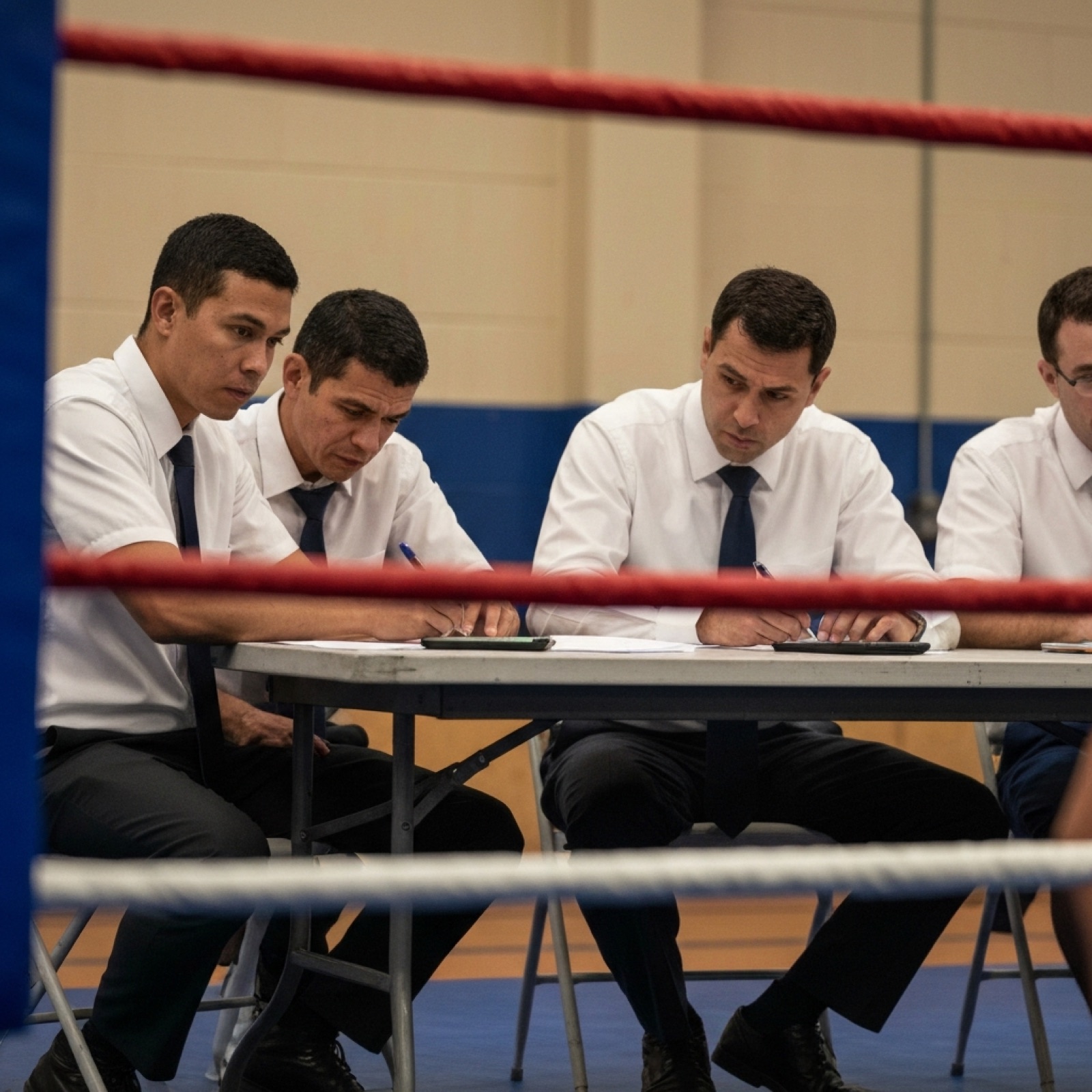
Take the scoring first. In a normal round with nothing unusual in it, the boxer who did the better work gets 10 and the other gets 9, so the round is scored 10-9. If a boxer is knocked down in the round, that usually costs him another point, so the round becomes 10-8. Add every round up at the end and you have the result.
Those famous scorecards read out at the final bell, like "116-112", are nothing more than the per-round scores added together. Twelve rounds, mostly 10-9 one way or the other, and the totals tell you who the official thought won more of them.
Now the officials themselves, because this is where Britain and the rest of the world part ways.
A couple of extras change how much the crowd gets to see. The WBC allows "open scoring", where the running totals are read out to the crowd after rounds 4 and 8, but only if the local commission agrees. Most fights keep the scores secret until the final bell. The WBC also allows instant replay for the big disputes, like whether a cut came from a punch or a clash of heads, or whether a blow landed after the bell. It is boxing's version of the video check they use in football, but only where the venue has the kit and the commission approves it.
Finally, what actually earns a point. A blow only scores when it is a clean hit with the knuckle part of the glove, landing on the front or side of the head, or on the body above the "belt". The belt here is an imaginary line drawn across the top of the hip bones, not the waistband of the shorts. Good defence counts too, so slipping and blocking shots is part of the scoring picture, not just landing them.
The winner of a round must be given 10 points and the loser 9 or fewer. A normal round is 10-9; a round with a knockdown is usually 10-8.
In plain English: Score each round on its own. Round winner always gets 10, round loser gets 9, minus one more for going down. Add up all the rounds at the end.
In ordinary British professional fights the referee in the ring is the sole scorer. Three ringside judges are used only for British and Commonwealth titles or specially designated bouts.
In plain English: In most British fights the ref alone decides the winner. Three judges only turn up for titles. American and world fights always use three judges.
Points come from clean hits with the knuckle part of the glove to the front or side of the head, or the body above the belt line across the top of the hip bones, plus good defence.
In plain English: Only a clean knuckle landing on the head or upper body counts, and solid defence counts too. A wild swing that grazes or misses earns nothing.
When two boxers are otherwise level in a round, the British rules give it to whoever does the most leading off or shows the better style. That is a wholly subjective call. And because only the knuckle part of the glove scores, and nobody can see the exact point of contact in real time, what counts as a scoring blow really comes down to the official's eye. Two honest officials can watch the same close round and mark it differently.
The scorecards are not a mystery. "116-112" is just twelve rounds, each marked 10-9 or 10-8, added up. Once you know a clean round is 10-9 and a knockdown makes it 10-8, you can score a fight from your sofa as well as anyone.
Ask most fans how long a big fight lasts and they will say 12 rounds without thinking. They are right, but only for the fights that matter most. In professional boxing the number of rounds is not fixed at 12 for every bout. It is a ceiling. No professional contest can go beyond 12 rounds, and title fights are pinned to exactly that number. Everything else can be shorter.
The plainest way to think about it is that 12 rounds is the deep end of the pool. A four-round fight on the undercard and a world title fight both live in the professional game, but they are asking very different questions of the boxer. One is a quick test. The other is 36 minutes of real boxing spread across the best part of an hour.
Here is how the distance actually works in the professional game:
The 12-round distance is also newer than a lot of fans realise. For decades the biggest world title fights ran to 15 rounds. That era ended on safety grounds. Those last three rounds came at the point where a tired, hurt boxer is least able to protect himself, and the sport moved away from them. Today 12 rounds is the ceiling almost everywhere. One rare exception survives on paper: California still technically allows 15-round title fights, but only with written approval from the commission, which is the state body that licenses the boxers and runs the night. It is a throwback that has been dropped nearly everywhere else.
Women's professional boxing runs to a slightly different clock. Women's championship rounds are usually 2 minutes long rather than 3. A minute may not sound like much, but it changes the whole pace of the fight, because a shorter round rewards a boxer who can be busy in bursts rather than one who slowly grinds an opponent down.
No professional contest may exceed 12 rounds or be less than 8 minutes of actual boxing. Rounds are 3 minutes with a 1-minute rest; in fights of 10 rounds or fewer, rounds may be reduced to 2 minutes.
In plain English: Twelve rounds is the most you will ever see. The shortest professional fight is still at least 8 minutes of real boxing, and shorter fights are sometimes run with 2-minute rounds.
Title fights and final eliminators are always 12 rounds of 3 minutes.
In plain English: Every world and British title fight, plus the eliminator that decides the next challenger, runs the full 12 three-minute rounds. There is no short version of a title fight.
Here is where it gets interpreted. The BBBofC lets women's championship contests be varied to 10 rounds of 2 minutes, but only if both boxers agree and the Board permits it in writing. So a women's title fight can be shorter than the men's standard, but never automatically. It takes agreement from both camps and sign-off from the Board, which is the same safety-first pattern you see across the professional rules: a shorter fight is allowed, but somebody with authority has to say yes first.
The 15-round era ended for one reason: those final rounds landed exactly when a tired boxer could least protect himself. The move to 12 was a safety decision, not a scheduling one.
A boxer goes down. The crowd is on its feet, and it looks like the fight is over. It is not, not yet. The referee steps in and starts to count, and the first job of that count is not to end the contest. It is to buy a few seconds so someone can look at the fallen boxer and decide whether he is fit to carry on.
Here is the surprising part. Even if the boxer springs straight back up, the referee does not simply wave the fight on. He must count all the way to 8 first. This is the mandatory 8-count, and it is a safety pause built into the rules on purpose. Those few seconds give the referee a moment to look the boxer in the eye, watch how he moves, and check that he is alright before letting the punches start again.
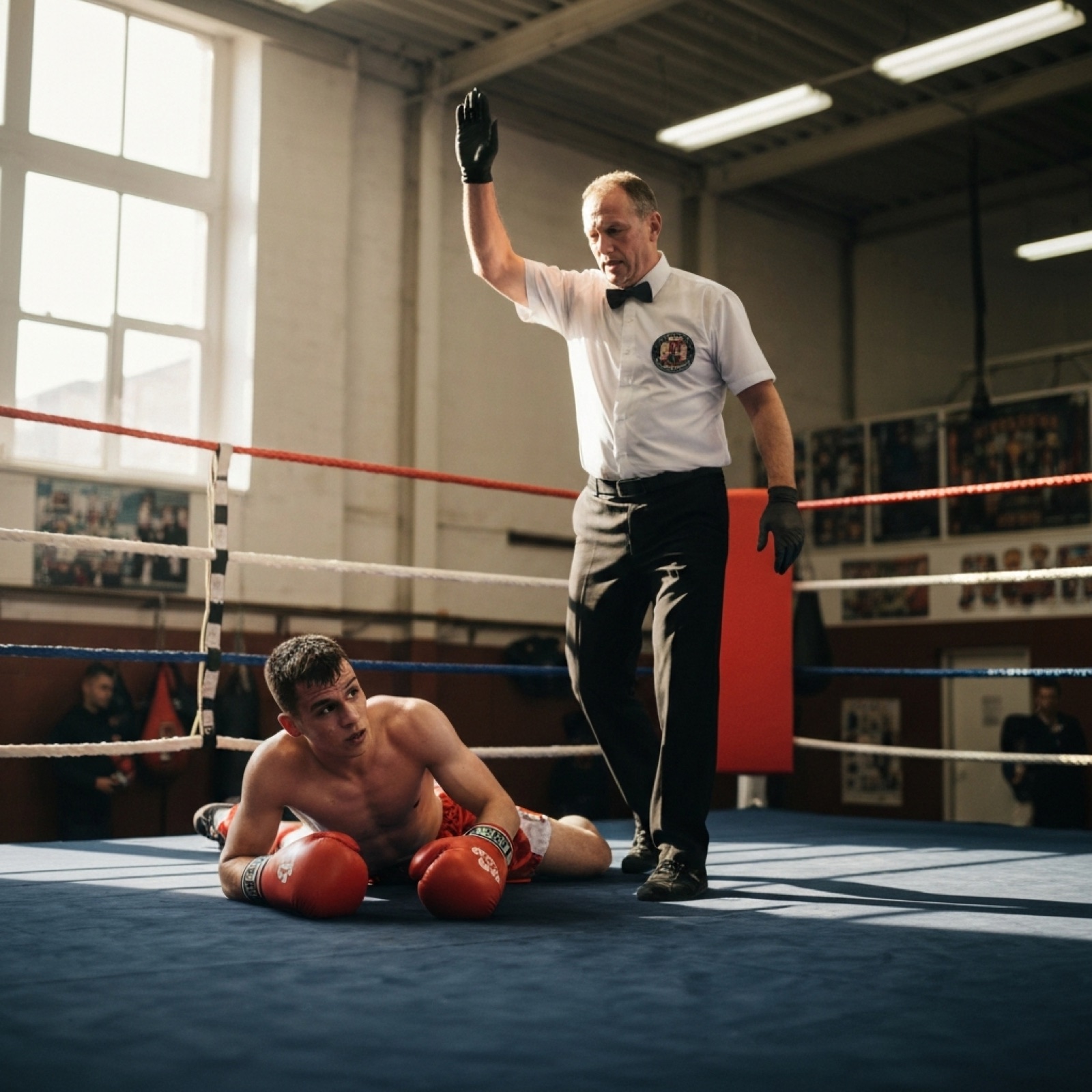
Three things about knockdowns catch most people out, because television and the movies get them wrong. Once you know them, you will watch the sport differently.
So what does "down" even mean? It is more than lying flat on the canvas. A boxer is counted as down when any part of him other than his feet touches the floor, when he is hanging helplessly on the ropes from a legal punch, when he falls out of the ring, or while he is still in the act of getting up.
A boxer knocked clean out of the ring gets a longer count to help him get back safely: 20 seconds to climb back in without help. If his corner or anyone else hauls him back in, it can cost him points or the fight.
On a British card the scoring punishment for a knockdown is brutal. The boxer who is put down, or who fails to beat the count, gets zero for that round and has a further 10 points taken away, while the winner takes 10. A knockdown does real damage to the cards, not just to the body. On a grassroots platform like BoxerConnect the fights are amateur, not professional, but the same instinct runs through both codes: the count exists to protect the boxer, never to hurry him back into harm.
After every knockdown the referee gives a full count of 8, even if the boxer is already back on his feet, before the fight can resume.
In plain English: A downed boxer always gets at least 8 seconds. The count is a forced safety check, not just a way of measuring whether he can stand.
A boxer who is down cannot be saved by the bell in any round, including the last. If the bell rings during the count, the count continues.
In plain English: The end of the round does not rescue a hurt fighter. He still has to beat the count himself.
Under most modern professional rules there is no automatic stoppage after three knockdowns in a round; the referee decides when it is too much. The WBA is a notable exception, where three knockdowns in a round is an automatic knockout.
In plain English: There is no fixed count of knockdowns that ends a fight. It comes down to the referee's judgement, except under WBA rules.
A boxer being held up by the ropes who, in the referee's opinion, cannot defend himself can be ruled down. So a fighter who is technically still standing can be given a count purely on one official's read of the moment. And because there is no three-knockdown rule, the point where a one-sided round becomes a stoppage is entirely the referee's call, with no number to reach. This is where the safety instinct has to win: the referee is trusted to stop it early rather than late, because the count is there to protect the boxer, not to give the crowd a longer show.
The count is not the referee deciding whether the fight is exciting enough to continue. It is the one moment built into every knockdown for someone to check a hurt boxer is safe to carry on. When in doubt, the rules trust the referee to stop it early.
Here is a thing that surprises a lot of people. The weight a boxer makes on the scale is almost never the weight he carries into the ring. The two numbers can be a stone apart. It is not cheating and it is not a trick. It is baked into how the sport schedules the weigh-in.
Most weigh-ins happen the day before the fight, not on fight day. So a boxer drains himself down to the limit, steps on the scale, and then has a full night to eat, drink and put the weight back on. By the time the first bell rings he is heavier, stronger and fully rehydrated. Rehydrate just means putting back the water and food he took out to make the number. The rules that govern this timing are some of the most safety-sensitive in the whole sport, and the belt bodies do not agree on them.

The starting point in Britain is simple enough. The BBBofC, the body that runs fight night here, requires the weigh-in not less than 24 and not more than 36 hours before the show. That is a day-before weigh-in as standard, which is exactly why a boxer can enter the ring well above the limit he made on the scale.
The trouble is that the four big belt bodies each set their own window, so a fighter can face a different rule depending on who is sanctioning:
That IBF second weigh-in is its signature safety rule. On fight morning, between 8 and 10am, the boxer steps on the scale again, and he cannot be more than about 10 lbs over his division limit. The idea is to stop a fighter draining down to make weight and then ballooning back up overnight, because a big overnight rebound is exactly the dangerous bit. A boxer who rehydrates by two stone is fighting well outside the division he weighed in for.
There is one gap worth knowing. That IBF morning weigh-in is waived for heavyweight championships and unification bouts. So an IBF heavyweight title fight, the division where the punches land hardest, actually faces less rehydration policing than a lower-weight one. It is a fair question why the safeguard drops away exactly where the fighters are biggest.
Making weight is not just about your own fitness. It can decide who owns the belt before anyone throws a punch:
There is a medical layer too. The WBC bans IV rehydration at any time. IV means into the vein, through a drip. Fighters used to drain their weight right down and then refill fast through a drip, which is hard on the body. California bans IV rehydration outright as well. The point is to make a boxer put the fluid back the slow, natural way, by drinking, so the number on the scale reflects something closer to reality.
And missing weight can cost real money. The WBA docks a fixed 35% of a fighter's purse when he misses, with 25% going to the promoter and 10% to the opponent. If he will not even try to make weight during the extension he is given, that rises to 45%.
The IBF holds a first weigh-in 20 to 30 hours before the card and a second weigh-in on fight morning, between 8 and 10am, where a boxer cannot be more than about 10 lbs over his division limit. This morning weigh-in is waived for heavyweight championships and unification bouts.
In plain English: The IBF checks a boxer twice, and the morning check caps how much weight he can pile back on overnight. But that check is switched off at heavyweight, the very division where it would matter most.
A champion who misses weight can lose the title before the fight. Even if he wins, the belt is at best left vacant; he cannot win it back that night. If the challenger misses weight, the champion keeps the belt win or lose.
In plain English: If the champion is over the limit, he has already lost his belt when he steps off the scale. If the challenger is over, the champion is safe no matter what happens in the ring.
The WBC bans IV rehydration at any time, and California bars IV rehydration outright.
In plain English: A boxer has to put his weight back on by eating and drinking, not by a fast drip into the vein.
| Rulebook | When they weigh in | Rehydration / second weigh-in |
|---|---|---|
| BBBofC (UK) | 24-36 hours before | Day-before standard; same-day allowed only if no weight lost after |
| WBC | 24-30 hours before | IV rehydration banned at any time |
| WBA | 16-36 hours before | 2-hour grace to make weight |
| IBF | 20-30 hours before + fight morning | 10-lb morning cap; waived at heavyweight |
The WBA's purse-forfeit percentages apply 'absent contractual provisions to the contrary'. So the two camps can privately agree a bigger or different missed-weight penalty that overrides the standard schedule, and in big fights that is common. Here is where it gets interpreted: the printed rule is a starting point, not a fixed law, and what actually happens if a fighter comes in heavy may have been written into the contract months before.
Making weight is where the sport's safety worries are most raw. The overnight rebound is the risky part, which is why the smartest rule here, the IBF morning check, is aimed squarely at it. The odd thing is that the check is switched off at heavyweight, exactly where a heavy rehydration matters most.
Most fights end the obvious way, on points or with a boxer beaten. But every so often the ending is decided by a rule most fans have never heard of. A clash of heads opens a cut, the doctor waves it off, and now the referee has to work out what just happened and who, if anyone, has won. Get the timing and the intent right and a fighter who was losing badly can walk away the winner. Get them wrong and there is no result at all.
This is the part of boxing where a lot rides on one official's split-second reading of a messy moment. So it is worth understanding what the fouls actually are, and how the clock quietly changes the answer.
A foul is a banned act, and the 2025 British book is unusually direct about the full list. It groups together several things that television commentary often treats as unrelated:
The referee must name the boxer at fault and tell them to stop. In the referee's sole discretion, and with or without reference to medical opinion, they may caution or disqualify the boxer. They may also deduct points. When points come off, the referee shows the boxer, corner and steward or area representative how many were taken and why. These powers can be combined, so it is not simply a choice of one caution, one deduction or one disqualification.
The corner is covered too. A second must not advise or assist in a way that distracts either boxer or the officials, or offends anyone else attending the promotion. A second who breaks the rules, ignores an order, harms either boxer or obstructs an official can be ordered from ringside and must leave immediately and calmly. When the referee calls "break", both boxers must immediately take one step back before boxing again, and forced separation should be avoided where possible.
Now the important part, the part that turns a foul into a result. When an accidental foul stops the fight, everything hinges on how far the fight has got. If a clash of heads opens a cut and the doctor stops it before 4 completed rounds, the fight is a technical draw (US rules call this a 'no decision'). Nobody wins. But if the same thing happens after 4 rounds, it becomes a technical decision, and the judges' scorecards up to that point settle it. Whoever was ahead wins. So a boxer can be miles behind, catch an accidental headbutt in the fifth, and lose the fight without ever being beaten in the ring.
An intentional foul is treated far more harshly. If a deliberate foul ends the fight, the boxer who did it loses by disqualification. If the fight can carry on, the referee must take off a mandatory 2 points, no discretion about it.
The belt bodies then add their own wrinkles on top:
Low blows have their own clock. A boxer hit low must get back to boxing within a reasonable time and no more than 5 minutes, or he forfeits the fight. And under many rulebooks a low blow can never actually end a fight, because the boxer is wearing a groin protector that is assumed to have taken the worst of it. On BoxerConnect and everywhere else in the amateur game these same principles about accidental versus intentional fouls carry through, even where the exact thresholds differ.
The Board names 15 types of prohibited conduct, including illegal targets and striking surfaces, holding and roughing, deliberate avoidance, ignoring the break, deliberately striking a falling or downed boxer, unsporting conduct and a referee catch-all.
In plain English: A foul does not need to look dramatic. Refusing to try, repeatedly ducking below the waist or taking a deliberate fall are on the same written list as low blows and rabbit punches.
Seconds must not advise or assist in a way that distracts either boxer or the officials, or offends anyone else attending the promotion. A second who breaks the rules, ignores an order, harms either boxer or obstructs an official may be removed and must leave immediately in an orderly manner.
In plain English: The corner is accountable too. A corner team member who interferes with the contest can be told to leave there and then.
When the referee orders a break, both boxers must immediately take one step back before they start boxing again. Forced separation should be avoided where possible.
In plain English: No holding for an extra beat and no free shot while the other boxer obeys. Both reset first.
The referee must name the boxer at fault and tell them to stop. With or without reference to medical opinion, the referee may caution or disqualify in their sole discretion and may also deduct points, showing the number and reason to the boxer, corner and steward or area representative.
In plain English: The powers are not mutually exclusive. A caution can be followed by a deduction, and serious conduct can still end in disqualification.
An accidental foul that stops the fight before 4 completed rounds is a technical draw (a 'no decision' in US rules). After 4 rounds it becomes a technical decision, and the boxer ahead on the scorecards wins.
In plain English: If a headbutt ends things early, nobody wins. If it ends things later, the fighter who was ahead takes it. The clock, not the cut, decides.
An intentional foul that ends the fight means the offender loses by disqualification. If the fight continues, the referee must deduct a mandatory 2 points.
In plain English: Do it on purpose and you either lose on the spot or hand your opponent 2 free points. The referee has no choice about the deduction.
A boxer hit by a low blow must carry on within a reasonable time but no more than 5 minutes, or he loses. Under many rules a low blow cannot end a fight because the groin cup is assumed to protect him.
In plain English: Get hit low and you have up to 5 minutes to recover, then you box on or you lose. You cannot stretch it into a long rest.
The entire result can flip on whether the referee labels a headbutt accidental or intentional. Accidental routes into the draw or technical-decision rule; intentional means a mandatory 2-point deduction or an outright disqualification. It is a subjective call with no guaranteed replay, and different bodies even set the round threshold at 4 or 5, so the same headbutt could be judged differently depending on whose rules apply that night.
The safety point sits underneath all of this: a boxer with a bad cut over the eye gets stopped whatever the scorecards say, because the doctor's job is to protect the fighter, not to reach a clean result.
Watch a professional fight and most of the kit is hidden in plain sight. The gloves look the same from the cheap seats, the hands underneath are wrapped in something, and when a boxer gets cut a man in the corner dabs at it with a swab. All three of those things are governed by strict rules, and the reasons behind them are almost always about safety, not show.
The short version is this. Gloves get bigger as the boxers get bigger. The tape under the glove is not allowed to turn a fist into a weapon. And the person patching up a cut cannot reach for whatever he likes - he has a short, named list of things he is allowed to use, and stepping outside it can lose his boxer the fight on the spot.

Start with the gloves. A professional glove is weighed in ounces, and the weight tells you how much padding is packed into it. The rule is set by division, which is the weight class a boxer competes in:
The bigger, harder-hitting fighters wear the heavier, more padded glove. That is deliberate. More power on the punch means more padding over the knuckle.
Now the head. Professionals fight bare-headed. There is no headguard, which is the padded helmet you see on young amateurs. The only protective kit a pro must wear is a properly fitted gumshield, which is the moulded guard that protects the teeth and jaw, plus a spare in case one comes out, and an approved groin protector. The bare head is the most obvious thing that separates the professional game from the amateur one.
Under the glove, the hands are wrapped. A boxer can use a soft bandage plus a limited amount of zinc-oxide or surgical tape, the same stiff medical tape you might strap a sprained ankle with. There is one rule that matters more than any other here: the tape must not go over the knuckles. The knuckles are the striking surface, and a hard band of tape laid across them would turn a padded fist into something closer to a brick. Keeping tape off the knuckles is exactly the safeguard that stops it.
Because the wraps matter so much, title fights add a check. An inspector, an official appointed by the governing body, watches the hands being wrapped, then signs or stamps the bandages before the gloves go on. The wraps can even be sealed and kept afterwards so they can be looked at again if anyone complains.
Then there is the cutman, the person in the corner whose job is to keep a bleeding boxer in the fight. This is where people are most surprised by how tight the rules are. During the round only plain water is allowed. Between rounds, on a cut, the corner may use only a short approved list:
The IBF goes further and names things that are absolutely banned. Iron-based clotting agents such as Monsel's solution are not allowed, and using one is an instant disqualification. So is reviving a groggy fighter with smelling salts or ammonia capsules, the sharp-smelling tricks corners used for decades. Those are on the WADA prohibited list, WADA being the World Anti-Doping Agency, and reaching for them costs the fight.
Gloves are 8 ounces up to and including welterweight, and 10 ounces from super-welterweight upwards.
In plain English: Lighter boxers wear 8-ounce gloves. Heavier boxers wear 10-ounce gloves, with more padding over the punch.
Hands may be wrapped with soft bandage plus limited zinc-oxide or surgical tape, but the tape must not go over the knuckles.
In plain English: You can strap the hand, but not the striking surface. That is what stops a fighter loading a harder edge over the knuckles.
During the round only plain water is allowed. Between rounds the corner may use only approved coagulants; iron-based agents like Monsel's solution and reviving agents like smelling salts are banned and cause disqualification.
In plain English: The corner cannot use whatever it likes. Step outside the named list and the boxer is disqualified.
| Feature | Amateur (Olympic-style) | Professional (BBBofC) |
|---|---|---|
| Headguard | Often required (waived for elite men) | None - fight bare-headed |
| Rounds | About 3 rounds | Up to 12 (title fights always 12) |
| Round length | Commonly 3 minutes | 3 minutes (2 optional in 10-rounders) |
| Scored by | Judges (points system) | Referee alone in ordinary fights; 3 judges for titles |
| Gloves | Standardised | 8oz to welterweight, 10oz above |
Normally both boxers wear the same make and model of glove. But for championship and Board-designated feature fights, the Stewards can let the two fighters wear different glove brands by mutual agreement. Different brands pad differently, so this is a quietly significant call, and it comes down to what the two camps agree and the officials permit.
The thread running through all of this is protection. Bigger gloves for bigger punchers, tape kept off the knuckles, and a locked list of what a corner can put on a cut are there to keep a boxer safe, not to slow the fight down.
Most of what keeps a professional boxer safe happens off camera, long before the first bell and long after the last. A boxer does not simply turn up on the night and fight. He has to pass a heavy medical gate to hold a licence at all, and if he takes a bad beating he is pulled out of the ring by rule, not by choice. None of this makes the papers, but it is the part of the sport that matters most.

In Britain the British Boxing Board of Control, the body that runs fight night, sets the medical rules. They are strict, and some of them are unusually strict compared with the rest of the world.
The United States runs its own version of the same idea. There is no single national body, so each state commission sets its own rules. California, for example, requires an annual neurological exam and imposes a minimum 30-day suspension after any knockout or stoppage, and keeps the boxer on an "ill and unavailable" list until he is cleared.
This is the layer that matching should always respect. When two boxers are put together, the age and weight and medical limits are not a suggestion. They are the whole point. On BoxerConnect, matching follows these same safety limits rather than working around them.
Every British boxer must file a satisfactory MRI brain scan report every year, plus an MR angiogram on first applying for a licence.
In plain English: You cannot hold a British licence unless a fresh scan of your brain, and its blood vessels the first time, comes back clear. It is checked every year, not once.
Any stoppage, count-out or retirement triggers an automatic medical suspension of 28 or 45 clear days or more, set by the Board's Senior Medical Officer.
In plain English: Get stopped or knocked out and you are barred from boxing for at least a month, by rule, no matter how well you feel afterwards.
An ambulance crewed by paramedics, reserved solely for injured boxers, must be on site all night, and no contest can start without resuscitation-trained staff present.
In plain English: No ambulance and trained staff, no boxing. The show does not begin until the safety cover is in the building.
The exact ban, "28 or 45 clear days or more", is set entirely by the Senior Medical Officer. So two boxers stopped on the same night can be given very different suspensions, and there is no fixed tariff that says which gets which. Most of the medical bars are absolute, but there is one small opening: eyesight below the required standard can still be allowed at the discretion of the Board. It is a rare exception in a set of rules that mostly does not bend.
If you take one thing from this section, take this: the medical rules are there to protect a boxer from himself on the night he most wants to carry on. A month out after a knockout is not red tape. It is a healing brain being given time it cannot ask for on its own.
A boxer can win the fight in the ring and lose it weeks later in a lab. Drug testing sits over the top of everything else in the sport, and a failed test can quietly rewrite a result that everybody watched happen. This is one area where "the fight is over" is not quite true until the samples come back clean.
The important thing to hold on to is who is doing the testing. In Britain it is not the belt bodies that run it, but an outside anti-doping agency working to a worldwide code. That code decides what is banned, how samples are handled, and how long a cheat sits out.
British boxing runs its testing through UK Anti-Doping, usually shortened to UKAD, which follows the WADA code. WADA is the World Anti-Doping Agency, the body that writes the global list of banned substances and the rules for testing them. When a boxer takes out a British licence, part of what he signs up to is submitting to UKAD authority and to WADA-compliant investigations. In plain terms, he agrees to be tested and to be dealt with under that worldwide rulebook.
What a failed test does to the result depends entirely on who failed it:
The belt bodies each bolt their own testing rules on top of that, and they are not all as strict as each other:
If the winner later fails a test, the fight becomes a No Contest. If the loser fails, his loss is recorded as a disqualification and the winner keeps the win.
In plain English: A drug test can change the result after the fight, but only the cheat gets punished. Beat a man who later fails, and your win is safe.
The IBF imposes a 1-year ban for a first doping offence, 2 years for a second, and permanent ineligibility for a third.
In plain English: Get caught once and you sit out a year. Twice, two years. A third time and you are finished for good.
Every IBF boxer's post-fight sample is split into an A part and a B part; a positive A triggers a re-test, and only a confirmed B sample brings sanctions.
In plain English: Your sample is split in two. One positive alone is not enough - the back-up half has to confirm it before you are punished, which gives you a fair chance to fight the finding.
| Body | First offence | Second offence | Third offence |
|---|---|---|---|
| IBF | 1 year out | 2 years out | Permanent ineligibility |
| WBA | At least 6 months; title vacated if champion | 2-year ban from WBA titles | (escalates per WADA sanction) |
| BBBofC (UKAD/WADA) | Result adjusted (No Contest / DQ) | Per UKAD sanction | Per UKAD sanction |
Several bodies only encourage testing and lean on the local commission or the promoter to actually carry it out. The WBA notes that only testing authorised or directed by the Association or the local commission counts. So how strictly an elite fight is tested can depend on where it is held and which testing pool the fighter is in. Two fights of the same standing can face very different levels of checking.
Whatever the belt-body wording says, the underlying point is safety and fairness: drugs that let a hurt fighter carry on, or that add unnatural power to a punch, are exactly the kind of thing head-trauma rules exist to keep out of the ring.
Women's professional boxing runs on the same broad system as the men's game: the 10-point must scoring, the mandatory 8-count, the day-before weigh-in, all of it. But a handful of rules are genuinely different, and the biggest one changes how a fight feels from the first bell. A women's championship round is usually 2 minutes long, not 3. That is a full minute shorter every round, and over a whole fight it adds up to a faster, busier pace.
The catch is that there is no single women's format either. The number of rounds is not the same from one belt body to the next, so two women's world title fights on the same weekend can be scheduled quite differently.
Here is what actually changes in the women's rulebooks:
None of this makes women's boxing a softer version of the men's sport. It is the same test of skill, timing and nerve. A few of the rules simply reflect different bodies and a sport that is still settling on one agreed format.
If you are pairing up fighters for a bout, matching on BoxerConnect follows these same age and weight limits, so the boxers you see are matched inside the rules, not around them.
Women's championship rounds are usually 2 minutes long, with a 1-minute rest between, rather than the 3-minute rounds boxed by the men.
In plain English: Every round is a minute shorter, so a women's title fight is faster and busier than a men's fight of the same number of rounds.
A negative pregnancy test is mandatory before every championship bout.
In plain English: A woman cannot box for a title without a negative pregnancy test first. It is a safety check with no equivalent in the men's game.
The women's rules say hair must be secured with soft and non-abrasive material, and that a pregnancy test must be negative, but they do not define what material counts, exactly when the test must be taken, or who checks it. That leaves those calls to the local commission and the inspector on the night, which is where the rule actually gets interpreted.
The pregnancy test and maternity protection are not red tape. They exist so that no woman has to choose between her health, a pregnancy, and the shot she has earned.
Most sports have one body in charge. One rulebook, one list of champions, one office you can ring up when something goes wrong. Boxing does not work like that, and once you see why, the whole confusing mess starts to make sense.
There is no single organisation running professional boxing. Instead there is a stack of them, and which ones apply depends entirely on where the fight is happening and what is on the line. The best way to picture it is a set of layers, one sitting on top of the next.
Start at the bottom with the local commission, because that is who legally runs fight night: the licensing, the officials, the medical checks. In Britain that is the same body all the way through, the BBBofC. In the United States it is different, and this is the part that surprises people.
There is no national American boxing body the way there is in Britain. Each state runs its own commission. Nevada regulates all its own combat sports and, importantly, sits at the top of its own legal pecking order even over the "unified" rules it has agreed to. California writes its own laws, its own medical manual and its own set of regulations. So two American states can genuinely differ on real rules:
Above the local commission sit the world-title bodies, the four belts you hear about: the WBC, WBA, IBF and WBO. They do not run the night. They decide who is champion, who has earned a shot, and they add their own title rules on top.
Below the world titles there is yet another layer: regional belts. These are real championships, just not world ones. The two big examples are the EBU, the European body, and the OPBF, which covers the Asia-Pacific region (the letters stand for Orient and Pacific Boxing Federation). Each runs its own championship system with its own conditions bolted on:
So how does anyone keep track? The honest answer is that the professionals work through a checklist for every serious fight. First, find the venue's commission, because that is the law of the night. Then add the rulebook of each sanctioning body for every belt or eliminator on the line. Then add the anti-doping rules and the women's or regional appendices that apply. Only then do you know the full set of rules a given bout is fought under.
And the paperwork does not stop even when one fighter beats everybody. If a boxer unifies belts, the bodies still want their due. A WBO champion who unifies without written permission can be stripped of the title, and each body still expects its own sanctioning fee every time a unified belt is defended. Winning the lot does not buy you out of the system. It just means you now answer to more of it.
Each US state runs its own commission. Nevada regulates its own combat sports and sits above the unified rules it adopts; California publishes its own laws, medical manual and regulations.
In plain English: There is no single American boxing body. Fifty states means, in effect, many rulebooks, and real rules can differ from one to the next.
The EBU (European) and the OPBF (Asia-Pacific) each run their own championship systems, with their own eligibility, defence timelines and medical rules.
In plain English: Between local shows and world titles there is a whole middle tier of real championships, each with extra conditions layered on.
A WBO champion who unifies without written permission can be stripped, and each body still charges its sanctioning fee for every defence of a unified belt.
In plain English: Beating all four champions does not free a boxer from the system. Every body still wants its say and its fee.
| Type | Examples | What they add |
|---|---|---|
| World-title bodies | WBC, WBA, IBF, WBO | Rankings, mandatories, purse bids, title rules |
| Regional belts | EBU (Europe), OPBF (Asia-Pacific) | Eligibility limits, defence timelines, extra medical rules |
| Local commissions | BBBofC, Nevada, California | Licensing, officials, fight-night law, medicals |
Any local commission can override any part of the unified rules, and any belt body can strip a fighter or refuse to recognise him on broad grounds like protecting its "good name and prestige". So the sport does not run on one law. It runs on a negotiated stack of them, layer over layer. That is precisely why boxing can never be tidied into a single global rulebook, however much fans might wish it could.
If you ever find yourself baffled about who is really in charge of a fight, you are not missing something. The right question is never "what is the rulebook?" but "which rules apply to this particular bout?", and the answer is always a small stack of them at once.
Reading the rulebook cover to cover, a few things stand out as fixable. Not complaints, just an honest wishlist from people who want the sport to be easy to follow and safe.
The BBBofC sets an automatic ban of 28 or 45 clear days or more after any stoppage, count-out or retirement, but the exact figure is left wholly to one doctor, the Senior Medical Officer, with no stated criteria. Two boxers stopped on the same night can walk away with very different bans. A short published tariff, setting a minimum number of days by the type of stoppage, would make the concussion-rest rule fairer and more predictable while still letting a doctor extend it.
The IBF's fight-morning weigh-in is one of its best safety rules, built to stop dangerous overnight rehydration, yet it is waived exactly at heavyweight and in unification bouts. That leaves the division where the punches carry the most force with the least rehydration policing. The rulebook should at least set out the safety reasoning for the carve-out, or swap the blanket waiver for a heavyweight-specific cap, so the safeguard is not simply missing for the hardest hitters.
The ABC and BBBofC draw the line between a technical draw and a technical decision at four completed rounds, while the WBC uses the start of round 5. For a fan, and sometimes for the officials, that one-round gap quietly changes who wins a fight stopped by a headbutt. Because so many bouts move between these rulesets, a clearly flagged, side-by-side statement of each body's threshold, rather than the figure buried in separate documents, would head off avoidable confusion and disputed results.
The WBA and WBO only encourage local commissions to test, and only testing that the body or commission authorises actually counts. That means whether an elite title fight is drug-tested at all can depend on the venue, a real gap in a sport with head-trauma stakes. The cleaner fix is to make post-bout testing to WADA standards compulsory for any sanctioned title bout, as the IBF's rules already effectively do, rather than leaving it to chance.
Across the BBBofC book and the belt-body rules, provision after provision defers to Board or referee absolute discretion, from adding judges to a fight, to ruling a standing boxer down on the ropes, to calling a foul accidental or intentional. For a casual reader, and often for the fighter himself, that makes it impossible to know in advance what will happen. A short note or a couple of worked examples alongside the most outcome-changing calls, the accidental-versus-intentional foul call above all, would make the rulebooks far easier to follow without taking judgement away from the officials.
It means one boxer holds all four major world belts at the same time, the WBC, WBA, IBF and WBO, having beaten the other bodies' champions. Because each body crowns its own champion in every weight class, holding all four at once is rare and hard-won. A fifth body, the IBO, sits outside this four-belt undisputed picture.
There are four rival sanctioning bodies, the WBC, WBA, IBF and WBO, and each one recognises its own separate world champion. They are private organisations, not one central authority, so each writes its own title rules and its own rankings. Interim titles and regional belts pile even more champions on top.
World and British title fights are always 12 rounds of three minutes, what people call the championship distance. Twelve is the pro maximum; the old 15-round era ended on safety grounds, though California still technically allows 15 with special written approval. Women's title fights are usually two-minute rounds, and the number of rounds varies by body, 9 to 11 for the WBA and 10 or 12 for the WBO.
The boxer who wins a round must get 10 points and the loser gets 9 or fewer; a normal round is 10-9 and a round with a knockdown is usually 10-8. When three judges are used, they add up the per-round scores to produce a card like 116-112. In an ordinary British fight there are no ringside judges at all, the referee is the sole scorer.
No. Pro boxing has no standing 8-count, so a referee cannot pause the action to count over a fighter who is hurt but still on his feet; he either lets it continue or stops it. The mandatory 8-count only applies after a real knockdown. There is also no three-knockdown rule under most modern rules, and no boxer can be saved by the bell in any round.
The standard weigh-in is 24 to 36 hours before the show, so fighters rehydrate overnight and step into the ring heavier than they were on the scale. The IBF adds a second weigh-in on fight morning, with a cap of about 10lbs over the limit, to rein that overnight rebound in, though it waives this at heavyweight. The WBC and California go further and ban rehydration by drip outright.
A champion who misses weight can lose the belt on the scales before a punch is thrown, and even if he wins the fight he can never win the belt back that night. If it is the challenger who misses, the champion keeps the belt win or lose, which heavily favours the man already holding it. Missing weight can also cost real money; the WBA docks 35 to 45% of the purse.
When an accidental foul like a headbutt stops a fight after a set number of rounds, the boxer ahead on the scorecards wins a technical decision. Before that round threshold it is a technical draw, or a no decision under US rules, and nobody wins. The threshold is four completed rounds under most US and UK rules, but the start of round 5 under the WBC.
No, pros fight bare-headed. The only compulsory kit is a properly fitted gumshield with a spare and an approved groin protector; there are no headguards. That bare head is the most visible difference from amateur boxing, though elite men's amateur boxing has now dropped headguards too.
They are the four major sanctioning bodies, and each one crowns its own world champion and writes its own title rulebook. They do not run fight night; the local commission, such as the BBBofC or a US state commission, does that. They differ on the details too, with the IBF running a second weigh-in and the WBC banning rehydration by drip while allowing open scoring and instant replay.
The book this guide is built on is hosted here as a PDF. The wider library links to each body's official source, because those change often and the official copy is always the one that counts.
Rulebooks change, and different bodies word the same idea differently. We keep this current for 2025 and link the official sources, but if you are making a call that decides a bout, a licence or a child's safety, read the official rulebook or ask your commission.