
Loading...
Loading...
The real rules of amateur boxing in plain English, anchored on England Boxing and set against the wider Olympic-style world.
Written for BoxerConnect and current for the 2026 rulebooks. This is a plain-English guide, not the letter of the law: for a decision that counts, use the official rulebook.
People imagine amateur boxing works like the Highway Code: one set of rules, the same everywhere, for everyone. It does not, and it has not for a few years now. The book that governs your bout depends on three things: who is running the show, how old you are, and which country you are standing in.
Here is the part that matters most for anyone reading this. If you or your child boxes at a club in England, you box under England Boxing. That is the rulebook. It decides who you can be matched with, how the fight is scored, when it gets stopped, and every safety rule that keeps a young boxer well. Everything else on this page is the wider world you may meet later, if a boxer ever steps up to the international or Olympic level.

Amateur boxing is no longer one agreed code. There are now three main lanes, and it helps to know what each one is for.
There is also WBC Amateur, a separate, non-Olympic ruleset. It is worth knowing about, but it politely steps aside for national federations: where a national federation's rules differ from its own, the national federation's rules win.
Now, this sounds more complicated than it really is on the ground, and here is why. Most national and continental bodies do not sit down and write a whole new technical rulebook from scratch. They take an international code, adopt it, and then add their own local layer on top, mainly for age bands, kit and welfare. Boxing Canada, for example, openly uses the World Boxing rules with a set of Canadian changes bolted on. So the core of a contest, three rounds and the way it is scored, tends to travel from country to country. The differences live in the details around the edges.
One more thing worth knowing about the English system, because it comes up often. England Boxing runs the whole lot on a digital platform called The Locker, with an electronic licence known as the Digital BCR1. Registration, medicals, suspensions and a boxer's full bout history all sit in that one place, on a screen rather than on paper.
England Boxing's book is the official rulebook every amateur club, coach, official and boxer in England must follow. It sets who can box whom, scoring, stoppages and all the safety rules.
In plain English: If you box at a club in England, this is your rulebook. Full stop. It is the one that governs every bout you have until the day you step up to international level.
The IOC removed IBA recognition in 2023 and ran Paris 2024 through a temporary Paris Boxing Unit. World Boxing was founded in 2023, got provisional IOC recognition in February 2025, and boxing returns at LA28 under the World Boxing pathway.
In plain English: If the goal is the Olympics, the road runs through World Boxing. IBA is a separate world of its own now, with its own competitions.
A boxer in England follows England Boxing at club level, but boxes under World Boxing rules the moment they step onto the international or Olympic pathway. The head guard on a junior head can come off when they reach Elite level, and the rules on eligibility and appeals change with the badge on the event. It is the same boxer, but the book has changed under their feet.
Wales and Scotland run their own home-nation governing bodies. But as the wider picture shows, national and regional bodies mostly take a parent code and add their own tweaks, rather than writing a whole separate technical rulebook. So the core contest, three rounds and the 10-point-must scoring, tends to travel. The local differences sit in the age bands, the kit and the welfare rules on top.
The single sentence to hold on to: if you box at a club in England, you box under England Boxing, and every age, weight and safety limit on this site follows that book. Matching on BoxerConnect follows those same England Boxing limits.
In the professional game you sometimes see a small, young fighter put in with someone bigger and more experienced, and everyone knows it is a mismatch. Amateur boxing does not allow that. The rulebook decides who is allowed to box you, and it keeps the two boxers close in age and weight. A coach cannot simply pick a bigger opponent because it makes a better night out. The limits are written down, and matches that break them do not get made.
The first thing to understand is that your age group is not set by your birthday. It is set by the year you were born. So everyone born in the same year sits in the same class, whether they arrived in January or December. There is one exception: the very youngest boxers, called Minors, are placed by their actual date of birth.

Here is how the age and weight matching works in England Boxing.
The rulebook also stops people arriving as fake beginners. Once you register with England Boxing you must stop competing in other combat sports. Any earlier experience in Muay Thai, MMA, kickboxing or karate has to be declared, and it is converted into a bout-count. For example, one MMA contest counts as 0.75 of a boxing bout. That way a hardened fighter cannot line up against a genuine novice by pretending to have never competed.
The same honesty rule applies to professionals. A pro can come back to the amateurs, but only as an Elite boxer, only after surrendering their professional licence, and only after passing their medicals. Hide prior experience and the punishment is severe: your record is voided and you are expelled from championships.
These same age and weight limits are what a matching tool on BoxerConnect follows when it suggests opponents, so a match that would break the rules is not offered in the first place.
Minors and Schools must be matched within 12 months of age and no more than 2kg apart in weight. Juniors and Youths can be within 24 months, with extra caution once the gap is over 12 months.
In plain English: The youngest boxers can only face someone within a year of their age and within about the weight of a bag of sugar and a half. It is designed to stop mismatches, not allow them.
On registering with England Boxing you must stop other combat sports, and prior experience in Muay Thai, MMA, kickboxing or karate is declared and converted into a boxing bout-count (for example, one MMA contest counts as 0.75 of a bout).
In plain English: An experienced fighter from another sport cannot pose as a total novice. Their past is turned into a rough bout-count so they get matched as experienced.
A Minor is a child from their 10th birthday to the end of the year they turn 11. A child under 10 can join a club and train but cannot box, spar or do a skills bout.
In plain English: Under 10s can turn up and learn, but no contact of any kind until they are 10.
| System | Youngest that can compete | Age-class names | Set by |
|---|---|---|---|
| England Boxing | 10 (Minors) | Minors, Schools, Junior, Youth, Senior | Year of birth (Minors by exact DOB) |
| World Boxing | U15 (13-14, run by national bodies) | U15, U17, U19, Elite (19-40), Masters (40+) | Calendar year of birth |
| IBA | School-age (13-14) | School-age, Junior, Youth, Elite (19-40) | Year of birth |
| WBC Amateur | 6 (Minis) | Minis (6-7), Chicks (8-10), Children, Intermediates, Juniors, Youth, Elite | Age brackets |
| Boxing Canada | 6 (Funbox) | Funbox (6-12), U13, U15, U17, U19, Elite, Masters | Year of birth (Funbox by DOB) |
Because classes go by birth-year but real matching goes by months, a boxer born in December and one born the following January can sit in the 'same' class and still be almost 12 months apart in actual age. That is perfectly legal, but for children it is a real gap, and a coach should check the months, not just the class.
A semi-contact karate points bout counts as just 0.25 of a boxing bout, rounded to whole numbers. So the sums can under-state or over-state how much real ring danger someone brings. It is the honest declaration, not the arithmetic, that is doing the safety work here.
The matching rules only work if experience is declared honestly. The maths is rough, so the safe match depends on the boxer and coach telling the truth about what they have done before.
Not long, and that is the point. An amateur bout is three rounds. That is it. There is no marathon here, none of the 4 to 12 rounds a professional signs up for. Three sharp bursts of boxing with a 1-minute rest in the corner between each one, and then it is over.
What does change is the length of each round, and it goes up as boxers get older. A 10-year-old is not asked to do what a grown Elite boxer does. The youngest box for a single minute at a time. The oldest box for a full 3 minutes, the same length as the professionals. Everyone in between sits somewhere on that ladder.
Here is how the round length steps up with age and level:
So the total amount of boxing is small, and for the very youngest it is tiny. A 10-year-old does three 1-minute rounds, which comes to 3 minutes of boxing spread across the whole night. That is deliberate. Short rounds mean a young boxer is never worn down over a long fight, and there is a coach and a referee watching every second of it.
The other systems land in the same place. World Boxing also runs every bout over three rounds, with the oldest boxers (Elite and Under-19) at 3x3-minute rounds, Under-17s at 3x2, and the same 1-minute rest between rounds. WBC Amateur puts its adults on full 3x3-minute rounds too, which is the full professional round length squeezed into the short amateur three-round shape. Different badges on the event, same basic contest.
There is one more limit that has nothing to do with a single fight and everything to do with the boxer's health. A boxer must have at least 12 hours' rest between bouts, and can never box twice on the same calendar day. So nobody boxes in the morning and again that evening. If matching happens on BoxerConnect, these same rest gaps and age limits still apply. The 12-hour rule is not about fairness in one contest. It is about not sending a tired, sore boxer back through the ropes before their body has had a night to recover.
Amateur bouts are 3 rounds with a 1-minute rest between each, not the 4 to 12 rounds of the professional game.
In plain English: Every amateur fight is three rounds long. You get a minute in the corner between each one. That is the shape of it, whatever the age.
A 10-year-old boxes 3x1-minute rounds; 11-year-olds and Schools 3x1.5-minute; Juniors 3x2; Youths 3x2 or 3x3; Senior Elite always 3x3-minute rounds.
In plain English: The younger you are, the shorter each round. One minute for the youngest, all the way up to a full three minutes for grown Elite boxers.
A boxer must have at least 12 hours' rest between bouts and can never box twice on the same calendar day.
In plain English: No boxer fights twice in one day. There has to be at least half a day's gap so a sore, tired body can recover before boxing again.
Short rounds are a safety feature, not a soft one. Keeping the youngest boxers to a single minute at a time means nobody gets worn down, and there is always a coach and a referee watching every second.
Look at a row of amateur boxers and the first thing you will notice is the padded helmet, the head guard, on nearly every one of them. Then you will spot the exception. Under England Boxing rules, senior men box with a bare head, and everyone else keeps the head guard on. That one split catches people out more than any other kit rule in the sport.
The kit is not decoration. Every piece is chosen to spread a punch out, keep boxers apart from each other's gear, and take away the small edges a fighter might otherwise gain. Once you know why each item is there, the rules stop looking fussy and start looking sensible.

Here is what an amateur boxer has to wear, and the thinking behind each rule.
A quick word on the gloves, because the numbers confuse people. A 12oz glove is not there to let a boxer hit harder. The opposite is true. More padding spreads the impact of a punch over a wider area and softens it. That is exactly why, in a mixed-weight bout, both boxers move up to the heavier, more cushioned 12oz glove rather than down.
Head guards are compulsory for every England Boxing category except senior male boxers, who box bare-headed. If a senior man is matched against a youth, both wear a head guard.
In plain English: Everyone wears the padded helmet except senior men. Senior women, and every boxer under senior level, keep it on. A senior man cannot choose to wear one in a normal senior bout, and cannot choose to take it off against a youth.
Gloves are 10oz for boxers 65kg and under and 12oz for boxers over 65kg. If a lighter boxer is matched with a heavier one across that line, both wear 12oz.
In plain English: Sixteen kilos each side of the 65kg line sets the glove. In a mixed-weight bout both boxers go up to the heavier, more padded 12oz glove, which protects the smaller boxer.
| System | Elite/senior men | Elite/senior women | Juniors & youth |
|---|---|---|---|
| England Boxing | No head guard | Head guard | Head guard |
| World Boxing | No head guard | Head guard | Head guard |
| IBA | No head guard | No head guard (from 1 Jun 2024) | Head guard |
| WBC Amateur | Head guard | Head guard | Head guard |
| Boxing Canada | Head guard | Head guard | Head guard |
Senior women still wear head guards while senior men do not, and that is a live equality debate inside the sport. IBA has since dropped women's Elite head guards as well, from June 2024, so even the international bodies do not agree on where the line should sit. This is an unsettled question, not a solved one.
Several brands are approved for ordinary bouts, but for championship finals England Boxing mandates Sting-brand gloves and head guards only. So kit choice actually narrows at the elite end, where you might expect it to widen.
Never share a gumshield or wear one that does not fit your own mouth. A loose or borrowed guard cannot protect your teeth or help absorb a shock, and that is the whole reason it is on the mandatory list.
Forget the idea of a computer somewhere counting every punch. Amateur boxing is scored round by round, and every single round has a winner. A panel of judges sits at ringside, and at the end of each round each one decides who did the better boxing. They do not agree a shared verdict. They score on their own, and the totals are added up at the end.
The key thing to understand is what wins a round. It is not the boxer who throws the most punches or lands the one big shot the crowd gasps at. It is the boxer who lands clean, quality punches on target, shows the better skill, and keeps fighting hard. A tidy jab that lands beats a wild swing that misses, every time.
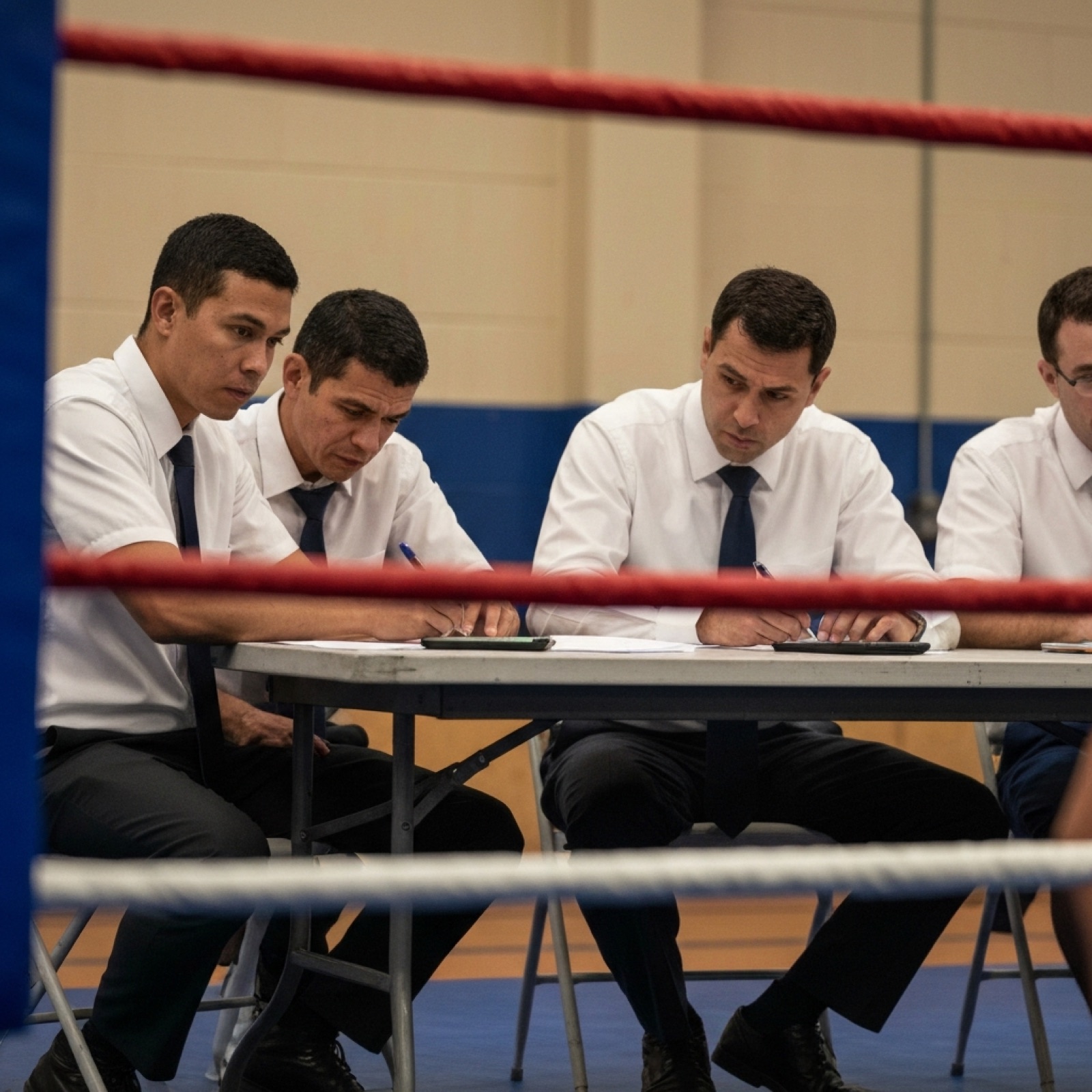
The maths is the same one you see on the television in professional boxing. It is called the 10-point-must system, because the judge must give the winner of the round a full 10 points. The loser gets fewer, and how many fewer tells you how one-sided the round was:
Add up every round on a judge's card and the higher total wins for that judge. Do that across the judges and you have your result.
One rule catches people out: a round cannot be scored even. Every round must have a declared winner, so a judge is never allowed to call it a draw and split the points 10-10. They have to pick someone, even in a round that looked dead level.
When a judge is deciding, they are weighing three things:
There is one more thing worth knowing about knockdowns. Putting your opponent on the canvas does not automatically hand you the round at 10-8. If the round was otherwise even, a judge can still score it 10-9. The knockdown is a big moment, but the judge weighs the whole three minutes, not just the one that hurt.
If you ever watch a bout on BoxerConnect, this is the same scoring you will see used at grassroots shows: three judges, 10-point-must, every round with a winner.
Each round, every judge gives the winner 10 points and the loser 9, 8 or 7. 10-9 is a close round, 10-8 a clear winner, 10-7 total dominance. The totals are added up and the higher total wins.
In plain English: The round winner always gets 10. How few points the loser gets shows how badly they lost it. Add up all the rounds to find the winner.
Every round must have a declared winner. A judge cannot score a round even.
In plain English: A judge is never allowed to call a round a draw. Even in a level-looking round, they have to pick someone.
Whether a round is 10-9, 10-8 or 10-7 comes down to one thing: how badly the judge thinks the losing boxer lost it. There is no fixed rule that turns X punches into a 10-8. That means three honest judges can score the very same round differently, and often do. A busy pressure fighter piling on the work against a slick counter-puncher picking clean shots can genuinely split a panel, with nobody being wrong.
The count of clean punches matters, but so does skill and how hard a boxer fights. That is why a neat, controlled boxer can win a round against someone throwing far more leather.
A knockdown is not the end of the fight, and it is not a formality either. It is the moment the referee stops being a spectator and becomes a safety brake. The instant a boxer goes down, the referee steps in, waves the other boxer to a neutral corner, and starts to count out loud, one number every full second. That counting is not there to add drama. It is there to buy a few seconds so that someone can look hard at the boxer who just got hit and decide whether they are fit to carry on.
The rule that surprises people most is this. Even if the downed boxer springs straight back up, grinning and ready to go, the fight does not restart. The referee must reach a count of eight first, every time. That is the whole point of it.
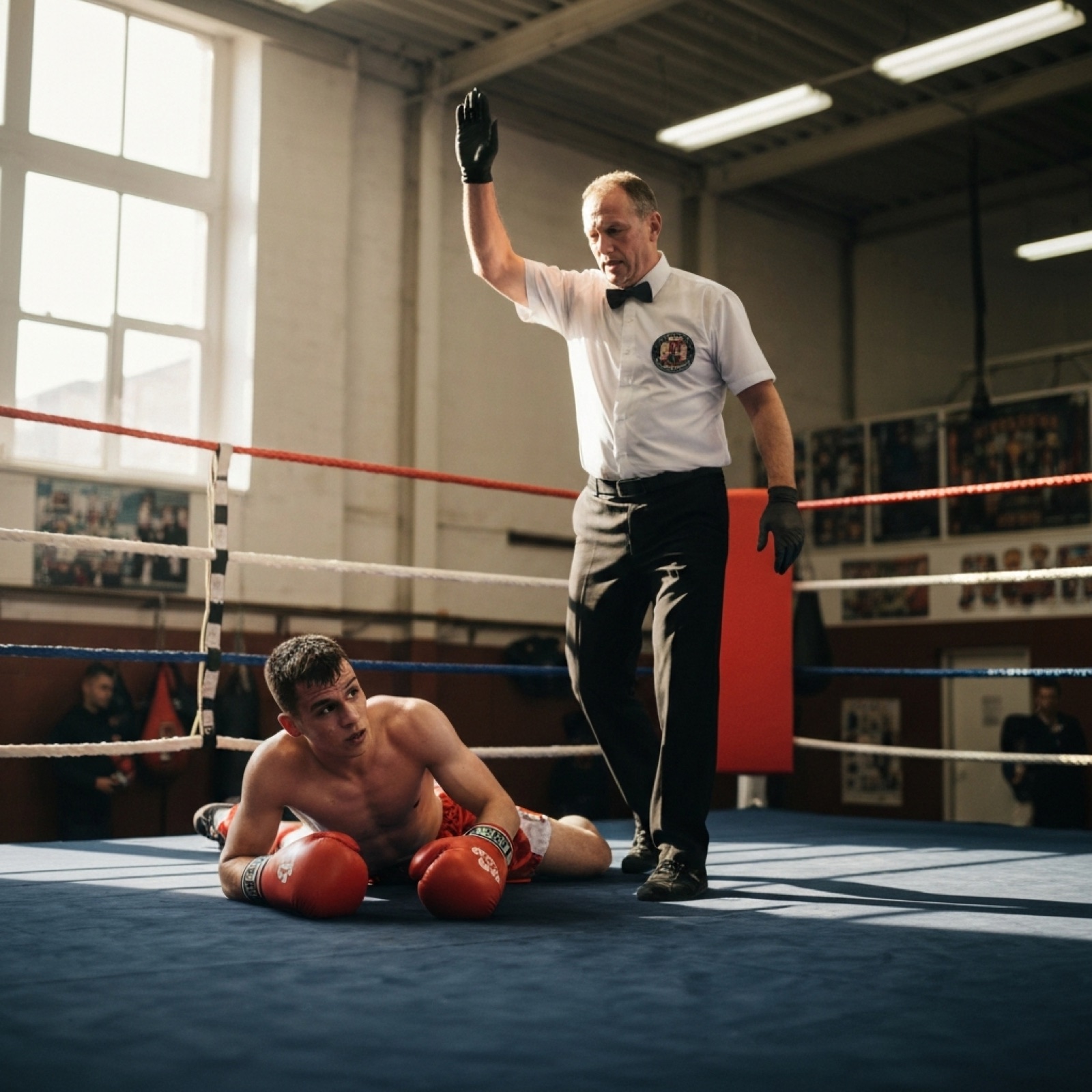
Here is what the referee is actually doing, step by step.
Put together, the count is a checkpoint, not a punishment. On BoxerConnect, the same age-group limits above apply to every boxer in the system, so a Minor is never held to a senior's count cap.
Even if the boxer gets straight back up, the bout cannot restart until the referee reaches a count of eight.
In plain English: Get up as fast as you like. The referee still counts to eight before you box on, purely so someone can check you are alright.
On a knockdown the referee counts 1 to 8 (a full second apart) if the boxer looks fit to continue, or 1 to 10 if not. Being counted to 10 is a knockout loss.
In plain English: The referee counts to eight if you look ready to box on, and to 10 if you do not. Reaching 10 is a knockout.
Seniors, youths and juniors may be counted a maximum of 3 times in a round and 4 in a bout; Schools and Minors a maximum of 2 in a round and 3 in a bout. At the limit the fight is stopped.
In plain English: There is a ceiling on how many times you can be dropped. Reach it and the referee ends the fight, and the ceiling is lower for children.
Counting to eight (carry on) versus 10 (all over) is a split-second call the referee makes in the heat of the moment. And because a boxer hanging semi-conscious on the ropes counts as down without ever falling, the referee's read of a dazed boxer is doing a lot of the work. This is where the safety of the sport rests on one person's eyes and instinct, which is exactly why the rules err toward stopping things early.
Because counts from illegal blows are left out of the cap, a bout can in theory run past the 3-per-round or 4-per-bout limit if some of the knockdowns came from fouls. That is deliberate. A boxer who has been fouled repeatedly is not pushed toward a stoppage for something that was not their doing.
A count is the sport looking after the boxer, not the crowd. If you are ever unsure whether a downed boxer should carry on, the honest answer is always to stop and check.
Most amateur bouts go the distance and are settled on points. But a fair number do not, and the referee holds the brake. If one boxer is clearly outclassed or taking too much punishment, the referee can wave the fight off at any moment. That is the single biggest difference from the professional game, where a badly beaten fighter is often left in there far longer. In the amateurs, the whole system is built to stop a one-sided fight early.
When you look at a result sheet you will see short codes rather than sentences. They are worth knowing, because they tell you exactly how the fight ended, not just who won.
Here are the codes you will see, in plain terms:
The referee's power to stop the contest is deliberately loose. There is no set number of clean shots that forces a stoppage. "Outclassed or receiving excessive punishment" is left to the referee's judgement, on purpose, so they can act the moment a fight stops being a fair contest.
Fouls do not usually end a bout on their own. They build up in three stages. First a caution, which is informal and costs nothing. Then a formal warning, which knocks 1 point off the offender's total from every judge. In a three-judge or five-judge panel, that is a big swing on the cards. A third warning in the same bout automatically disqualifies the boxer and hands the win to the opponent.
Being on the wrong end of a foul does not have to cost you the fight. If a boxer is hit by a low blow and cannot continue, they get up to 90 seconds to recover. If they still cannot box after that, they do not lose. They win by RSC(I), and the boxer who threw the low blow is the one who loses.
One more thing that surprises people from the pro world: there is no appeal against a result. Once the decision is announced in England Boxing, it stands. The same "no protest, no appeal" rule applies in World Boxing and WBC Amateur. What is said in the ring is final.
A referee may stop a one-sided contest at any point where a boxer is outclassed or receiving excessive punishment.
In plain English: There is no minimum number of rounds or punches. The moment the fight stops being a fair contest, the referee can end it. That early brake is why amateur boxing looks safer than the pro game.
Fouls escalate from an informal caution, to a formal warning that removes 1 point per judge, to a third warning that automatically disqualifies the boxer.
In plain English: A caution is free. A formal warning is expensive, because it takes a point off every judge's card. Collect a third warning in the same bout and you are disqualified, and your opponent wins.
A boxer unable to continue after a low blow is given up to 90 seconds to recover; if they still cannot box, they win by RSC(I).
In plain English: If a genuine low blow leaves you unable to carry on, you are not robbed of the result. You get 90 seconds, and if you still cannot box, you win and the fouler loses.
| System | Appeal a bout result? | What's possible instead |
|---|---|---|
| England Boxing | No - decision final | Supervisor may fix a referee technical error; scores shown as totals only |
| World Boxing | No - decision final | Bad judges quietly dropped via automated evaluation, not overturned results |
| WBC Amateur | No - never accepted | Commissioners can never alter the judges' verdict |
| IBA | Limited | Referee Error Protest only (not judging, not finals), within 30 min, max 2 per team |
The referee decides whether a low blow was hard and intentional (which means an instant disqualification) or accidental (a count and a chance to recover), and whether the victim is genuinely unfit to carry on. A boxer who is losing badly has an obvious reason to make a borderline low blow look worse than it was. That is exactly why faking or simulating a foul is itself a foul the referee can punish. The safety rule and the honesty rule are meant to work together.
A losing boxer cannot appeal, but the governing body can still unwind a result in narrow cases. If the supervisor spots a technical rule error, or if the winner is later found to have lied about their experience under the Championship Entry Infringement Protocols, the result can be undone. That is not an appeal by the boxer. It is the organisation correcting its own error or catching a cheat.
A referee stopping a fight early is not a sign the sport is soft. It is the sport doing its job. A boxer who is outclassed one night is not written off, they are protected so they can come back another night.
Amateur boxing is meant to be clean. A foul is any of the things the rules put out of bounds, and the referee is there to catch them. Most of the time a foul does not end your night. It costs you. But get it wrong three times and you are out, and the win goes to the other boxer.
The important thing to understand is how a foul is punished. There are three steps, and each one is heavier than the last: a quiet word, a formal warning that hits your score, and finally disqualification. A single warning is not a telling-off. It is a real dent in the cards.
The banned actions are the ones fans tend to spot from ringside. Under England Boxing the list includes:
When a boxer fouls, the referee can caution, warn or disqualify, and it is the referee's judgement which one fits. A caution is informal and costs nothing. A formal warning is where it starts to bite: each warning removes 1 point per judge from the offender's total. Across three judges that is 3 points gone in one go. Across five judges it is 5. That can be more than a whole round is worth, so a single warning can swing a scorecard hard.
The third warning in a bout disqualifies the boxer automatically, and the win is handed to the opponent. So warnings stack toward a hard limit, and the referee is counting.
Two more points are worth knowing. First, in IBA and World Boxing an illegal headbutt or blow that causes a cut or injury can bring instant disqualification, even when it was an accident. Second, pretending to be fouled is itself a foul. "Faking" or "simulating", say by exaggerating a low blow to win yourself a break, can be penalised the same as any other offence. The rules will not let a boxer buy a rest by acting hurt.
A boxer who fouls is cautioned, warned or disqualified at the referee's discretion; the third warning in a bout automatically disqualifies the boxer and hands the win to the opponent.
In plain English: A caution is free. A warning is formal. Collect three warnings in one fight and it is over, and the other boxer wins.
Each formal warning removes 1 point from the offender's total on every judge's scorecard.
In plain English: One warning takes a point off all three (or all five) judges at once, so it can cost more than a whole round is worth.
The line between an informal caution, which costs nothing, and a formal warning, which takes a point off every card, is entirely the referee's discretion. So two boxers can commit the identical foul and pay very different prices, and how quickly a referee decides to escalate feeds straight into the score. That is not a flaw to exploit. It is the referee reading the fight in real time and deciding what keeps it safe and fair.
A warning is not a scolding, it is points off the board, and three of them ends your night, so the safest boxing is also the tidiest.
The single hardest rule in amateur boxing is not about punching. It is this: no doctor, no boxing. Every show has a ringside doctor registered with England Boxing, and if that doctor ever steps away from ringside, all boxing stops until they or a replacement is back in the chair. Not the next round. That instant.
The rest of the safety system follows the same spirit. A boxer who is knocked out by head shots is made to rest whether they feel fine or not, because the person best placed to judge a head injury is a doctor, not the boxer who just took it. And the weigh-in is built to leave almost no room for the dangerous crash-dieting that older, heavier combat sports are famous for.

Here are the safeguards that sit around every amateur bout.
A word on why the concussion rest is so firm. A boxer who has just been stopped is often the worst judge of their own head. The whole point of a mandatory stand-down is to take that decision out of their hands and hand it to the doctor and the calendar. On BoxerConnect, a boxer's suspension is part of their record, so a coach cannot accidentally match someone who is meant to be resting.
A boxer knocked out by head blows or diagnosed with concussion is suspended a minimum of 30 days. Two head-blow knockouts or stoppages within 3 months means 30 days from the second; three within 12 months means a one-year ban. The ringside doctor sets these and they cannot be waived.
In plain English: Get badly caught around the head and you are made to rest, even if you feel fine. Do it again and the rest gets much longer. The doctor decides, and nobody can talk them out of it.
Every show needs a ringside doctor registered with England Boxing as an absolute medical minimum. If the doctor leaves ringside, all boxing must stop until they or a replacement returns.
In plain English: There is always a doctor watching from the ropes. If they walk away, everything stops until a doctor is back. There is no boxing without one.
After a suspension, a concussed boxer climbs a step-by-step ladder (rest, light exercise, drills, non-contact, full contact, competition), must be symptom-free at each step, and cannot return to competition before day 35 after the injury.
In plain English: You do not go straight from a knockout to a fight. You climb back up one rung at a time, and only if you feel fine at each stage. The earliest anyone competes again is 35 days after the injury.
| Trigger | England Boxing | World Boxing | WBC Amateur |
|---|---|---|---|
| One KO / head-blow stoppage | 30 days minimum | 30 days (90 if loss of consciousness) | 4 weeks |
| Two within 3 months | 30 days from the 2nd | 90 days from the 2nd | 3 months |
| Three within 12 months | 1 year | 1 year | 1 year |
| Return gate | Graduated Return + doctor clears | Doctor/neurologist + scan advised | Neurologist clearance, EEG advised |
Here is where it gets interpreted. If a fight is stopped for head blows but the doctor does not diagnose concussion, no suspension is strictly required, though the doctor may still give one if they feel it is appropriate. So the doctor's call at ringside is what decides whether a stand-down applies. The safety instinct is to err on the side of resting the boxer, and a cautious doctor will.
At the National Amateur Championships boxers get a 2-hour weigh-in window and may make weight naked if required, which is a far looser regime than a club show's single 1-hour weigh-in. So where you box changes how tightly your weight is policed. The tight club rules are the strictest version, not the only version.
If in doubt about a bang to the head, sit the boxer out and let the doctor decide. The rest days are cheap. A second injury on top of an unhealed first one is not.
Standing a nervous 10-year-old in front of a crowd for their first fight is a lot to ask. So amateur boxing does not ask it. It has a set of gentle first steps: controlled contests with no winner, no loser, and no result to carry around. You get the experience of walking to the ring, touching gloves and boxing in front of people, without any of the weight of a real fight. There is nothing like this in the professional game, where every bout is for keeps.
The main on-ramp is the skills bout. It is built for boxers aged 10 to 15 who are learning the ropes. The whole idea is light and controlled, so the rules take the pressure out of it:
Skills bouts are a stepping stone, not a place to hide. A boxer can have a maximum of six of them, and each one counts as half a real bout. After that, they must start boxing competitively. And the moment a boxer has had one real competitive bout, or turns 16, the door closes: no more skills bouts. It is a way in for beginners, not a permanent soft option.
For adults and older beginners there is a different first step, called For One Night Only. This is a sanctioned one-off bout for a complete beginner with zero prior experience. Before they can take it, they must have done a minimum of 12 weeks of training. The bout itself is over 3 rounds of 2 minutes, in 12oz gloves, which are the heavier, more cushioned gloves that spread out the impact of a punch.
There is also a new safety floor coming in. From June 2026, before a boxer can have their very first bout of any kind, they must have a recorded annual medical and 30 days of active sparring behind them. That holds true even for someone who arrives with prior experience in another combat sport. Nobody boxes for the first time straight off the street.
This welfare-first idea is not unique to England. Boxing Canada runs its own version called Funbox, for children aged 6 to 12 and compulsory for the 6-to-10s. In a Funbox contest there are no losers at all: both children are declared winners, and, as with skills bouts, the coaches cannot coach from the corner.
Skills bouts are for boxers aged 10 to 15, with no heavy punching or aggression. They are not scored, there is no winner, and coaches may not instruct from the corner.
In plain English: A controlled first contest for kids that looks like boxing but keeps no score, so a nervous beginner gets ring experience without a real result hanging over them.
A boxer may have a maximum of six skills bouts, each counting as half a real bout, after which they must box competitively. Once a boxer has had a real competitive bout or turned 16, they can no longer do skills bouts.
In plain English: Skills bouts are a limited on-ramp, not a permanent easy option. After six, or after a first real fight, or at 16, that gentle door closes.
Here is where it gets interpreted. If the supervisor and the referee both agree that a boxer has advanced beyond skills bouts, they can flag "No Further Skills Bouts" on that boxer's record. It is a judgement call, and it exists to stop a genuinely talented child sitting comfortably in the beginner category and outclassing real beginners. Two officials have to agree, which keeps it from being one person's whim.
These gentle on-ramps carry the same protection as any other bout. A skills bout still only pairs children close in age and weight, and matching on BoxerConnect follows those same age and weight limits.
Step outside England and the shape of the sport stays the same. Three rounds, judges scoring each one, a referee ready to wave it off. That core travels everywhere. What changes, and changes more than most people expect, is the fine print: who keeps a head guard on, how heavy the gloves are, whether you can argue with a decision, and who is even allowed in the women's category.
You do not need to memorise four rulebooks. But if you follow the sport, or your boxer moves onto an international pathway, it helps to know where the systems quietly part company. Here is where they split apart.
The four main systems, England Boxing, World Boxing, IBA and WBC Amateur, agree on the three-round contest and disagree on almost everything around its edges. The big divides are gloves, head guards, whether professionals can step in, and who is eligible to box in the women's category.
At the first weigh-in a World Boxing boxer must be over the minimum weight for their class as well as under the maximum, or they lose by walkover.
In plain English: Most people know you can miss weight by being too heavy. Under World Boxing you can also fail it by coming in under the floor for your class, and the penalty is the same: you forfeit the bout.
In its own flagship events, IBA drops Elite men to 8oz gloves rather than the usual 10oz to 12oz.
In plain English: A lighter glove has less padding, so punches land harder. The same weight class can therefore wear a different, harder-hitting glove depending on which body is running the event.
| Rule area | England Boxing | World Boxing | IBA | WBC Amateur |
|---|---|---|---|---|
| Elite men head guard | Off | Off | Off | On (all wear one) |
| Elite women head guard | On | On | Off (from Jun 2024) | On |
| Pros in the ring | No (must surrender licence) | Olympic pathway | Yes, if affiliated | Amateurs only |
| Sex eligibility | Interim / birth-sex, no HRT route | Genetic SRY test (over-18s) | Chromosome test (XY/XX) | Non-pregnancy cert only |
| Appeal a decision | No | No | Limited referee-error protest | No |
World Boxing and IBA now gate the women's category behind genetic or chromosome testing, while England Boxing openly calls its own rule an interim placeholder pending a future transgender inclusion policy. The systems do not agree, and the topic is being actively contested across world sport. This is honestly unsettled, not a solved question, and the honest thing to say is that it will keep moving.
IBA and World Boxing both welcome professional boxers, coaches and officials. So a fan can now watch genuine professionals in an 'amateur' ring, blurring a line that used to be absolute. England Boxing holds the older line, but the international bodies have moved.
If your boxer ever steps from a club show onto an international pathway, do not assume the kit and eligibility rules follow them. Check the sanctioning body's book for that specific event, because the head guard, the glove weight and the eligibility gate can all change with the badge on the show.
Reading the rulebook cover to cover, a few things stand out as fixable. Not complaints, just an honest wishlist from people who want the sport to be easy to follow and safe.
The whole difference between an 8-count that lets the fight go on and a 10-count knockout hangs on a referee's snap read of whether a boxer is 'fit to continue', and a dazed boxer hanging on the ropes counts as down without ever hitting the floor. The book gives no observable checklist for either. IBA already tells its referees not to count a semi-conscious boxer but to stop the fight instead, and borrowing that clearer, safety-first wording would take the guesswork out of a dangerous moment.
If a fight is stopped for head blows but the doctor does not formally diagnose concussion, no rest period is required and the boxer can walk out with nothing enforced. A brain bleed can be there even when a boxer looks perfectly fine, so a boxer stopped by repeated head shots deserves a precautionary stand-down as a matter of course. Making any head-blow stoppage trigger a minimum rest, as World Boxing broadly does, would be both safer and simpler.
England Boxing is honest that its gender-eligibility section is an interim placeholder, written while a fuller policy is worked out, but a boxer or parent reading only that page could easily take it as settled. A dated note at the top, saying plainly that this is an interim policy under review, would stop a temporary rule reading as a permanent one. This is an area the sport itself admits is unfinished.
Categories are set by year of birth, but real matching goes by months apart, so two children in the same class can legally be almost 12 months apart in age. That is a real gap for a child, and the book never spells the tension out for the coach making the pairing. A worked example, showing that a December-born and a January-born of the same class can be nearly a year apart, would push coaches to check the months and not just the class.
A club-show weigh-in is a single 1-hour window with very tight tolerances, but at National Championships boxers get a 2-hour window and may make weight naked if required, a materially looser regime tucked away in a separate clause. A boxer who prepares for one and turns up to the other is preparing for the wrong standard. A short note next to the club-show rule, flagging that championships differ, would clear this up.
The head-guard rule, the 10oz versus 12oz glove split, and the mixed-weight override all sit in separate clauses, and they change again the moment a boxer steps onto the World Boxing or IBA pathway. A single decision table, keyed to age, sex, and level, with a line noting that international events differ, would spare a coach cross-referencing four sub-rules before every bout. On BoxerConnect, matching already follows these same age and weight limits, so having them in one place would line up neatly with how matches are actually made.
In England Boxing, only senior men box bare-headed. Senior women and everyone below senior level must wear a head guard. The Olympics dropped them for elite men after evidence they did not reduce concussion, so it is a rule fixed by your category, not a personal choice. The bodies do not fully agree either: IBA has had elite women box bare-headed since June 2024, while WBC Amateur and Boxing Canada keep head guards on for everyone.
Three rounds, with a 1-minute rest between each, not the 4 to 12 rounds of the professional game. The length of each round steps up with age, from 1 minute for the youngest up to full 3-minute rounds for senior Elite boxers. A boxer must rest at least 12 hours between bouts and can never box twice on the same day.
A child can join a club and train at any age, but nobody under 10 can box, spar, or even do a skills bout. Competitive boxing starts at 10, with three 1-minute rounds. For nervous beginners aged 10 to 15 there are also unscored skills bouts, with no winner and no shouting from the corner, as a gentler way in.
RSC stands for Referee Stops Contest. The referee ends a one-sided fight because a boxer is outclassed or taking too much punishment, and it is the amateur version of a professional TKO. RSC-I means the fight was stopped for an injury, and RSC(I) can also be awarded to a boxer who is fouled and cannot carry on. An amateur referee can wave a fight off at any time, far sooner than in the pros.
It runs on the 10-point-must system: each round the winner gets 10 and the loser gets 9, 8, or 7, and every round must have a winner. The judges are watching for quality punches landing on target, technical and tactical skill, and how hard a boxer fights, not simply who throws the most. In World Boxing and IBA, five judges score each round and the referee scores nothing.
A knockout from head blows, or a diagnosed concussion, means an automatic ban of at least 30 days, set by the ringside doctor and not up for debate. Two within three months means 30 days from the second one, and three within 12 months means a full year out. World Boxing adds a 90-day ban if the boxer actually lost consciousness.
Amateur bouts are three short rounds, where professional bouts run from 4 to 12. Amateurs weigh in on the same day, close to the bout, which leaves little room for the extreme weight cutting seen in the pros, and referees stop one-sided fights far sooner. There is no appeal against an amateur result, and, senior men aside, most amateurs wear head guards, though IBA and World Boxing now let genuine professionals into their rings.
No. In England Boxing, World Boxing, and WBC Amateur, a bout decision is final the moment it is announced. A coach can ask to see the scores in writing within 20 minutes, but only as totals in random order, so there is no picking apart a single judge. IBA is the one exception, allowing a narrow Referee Error Protest, within 30 minutes and never for judging or for finals.
Yes. Every female boxer signs a non-pregnancy declaration at annual registration, and a parent or guardian signs it if she is under 18. A boxer declared pregnant is barred from boxing. World Boxing goes further and requires a signed declaration within one month of every competition. It is a hard medical gate that a lot of casual fans do not realise is there.
In England, a professional can return to the amateurs as an Elite boxer, but only by surrendering their professional licence and passing medicals. Prior MMA, Muay Thai, or kickboxing experience must be declared and is converted into a bout-count, so one MMA contest counts as 0.75 of a boxing bout and nobody can pose as a total novice. IBA and World Boxing now openly allow serving professionals to compete once they are affiliated.
The book this guide is built on is hosted here as a PDF. The wider library links to each body's official source, because those change often and the official copy is always the one that counts.
Rulebooks change, and different bodies word the same idea differently. We keep this current for 2026 and link the official sources, but if you are making a call that decides a bout, a licence or a child's safety, read the official rulebook or ask your club or association.